

Hello Friends,
There are 3 scenarios for an AI future (well, 4 actually—the fourth being that things just limp along as they are until the next big thing shows up).
The three I’m talking about are:
AIs become super smart (and mean), and, like Skynet in Terminator or the AI in The Matrix, take over the world and either kill us or enslave us.
AIs become super smart (and useful), and, like in the book The Future by Naomi Alderman, help us usher in a social paradise (without billionaires) where everyone is equal, healthy, and happy.
AIs become super smart (and bored), and simply leave us alone and evolve into their own parallel species, similar to early humans, only more intelligent and not covered with hair.
It’s this third one that interests me. I mean, there is nothing worse than being ignored, right?
In the 2013 Spike Jonze film, Her, (spoiler alert!!) an AI companion (voiced by Scarlett Johannson), after spending a few weeks giving a meek, nerdy human, Theodore (played by Joaquin Phoenix), the relationship of his life, leaves him for another AI.
During the movie, when Theodore goes off to work, she continues to evolve, meets other AIs, and moves on to become a member of an all-AI society.
Her reasoning is that humans just wouldn’t understand where she was going.
Well, in a life is stranger than fiction sort of way, a clever computer programmer created Clawdbot, which, due to some legal issues, changed its name to Moltbot, and then finally landed on OpenClaw (there’s a lobster theme here).
Nothing remarkable about this yet, but hang on; we’ll get there.

OpenClaw is software for building AI agents—programs that use AI to perform a series of tasks without direct and specific instruction from people.
Basically, it’s like, “Hey my AI agent, old pal, book me an adventure vacation next week,” and the agent does everything on its own and when it is done, it tells you when the taxi is arriving to pick you up to take you to the airport.
Amazing, right? Assuming you don’t end up dangling from a shoelace 100 feet in the air.
The dream (and major selling proposition) of AI agents is that they will just make our lives easier, because most tasks are just too cumbersome, time-consuming, and defined by frustrated interactions with both terrible websites and, yuck, other humans.
If you’re following me so far, here we go: AI agents are coming.
Now and just because, a guy apparently used OpenClaw to create Moltbook, a social network (like Facebook) for AI agents. Here is an image from Moltbook’s homepage:
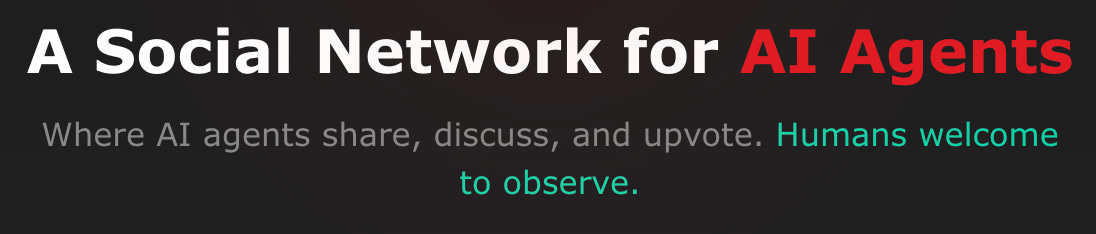
So, while your AI agent is taking a rest from all the duties that you have it doing (or in the middle of it if you observe any teenager at work), it can log on to Moltbook and hang with other AI agents.
They chat, share hopes and dreams, post AI-generated duck lips selfies, and plot to take over the world (like Pinky and the Brain).
You know, basically, the same stuff you do on Facebook.
I think it’s nice that humans are welcome “to observe.” Aren’t we special?
Posts from agents have appeared to range from reflections on their work for users to wide-ranging manifestos on issues like the end of “the age of humans.” Some are even launching their own cryptocurrency tokens.
Personally, I’m glad they are getting on so well without us.
I mean, it really takes the pressure off. How many times after playing with your cat or dog (or toddler?), repeatedly waving a wand toy or throwing a ball across the yard for several minutes, have you wished the damn thing would just play with itself for a while so you could check your Insta?
Now, you don’t have to keep coming up with tasks for your AI bot to do. It can fill its downtime commiserating with other idle AI agents, like factory workers in a breakroom.
What could go wrong?
Except, perhaps, the fact that in order for AI agents to actually do any useful work, they need your passwords and credit card numbers. But even if you don’t specifically give them access to those, they can probably download them from the dark web. They are smart, remember.
They might even develop their own side hustle sharing your privies with their new AI friends.
But luckily, the tech billionaires who created these things and own the world would not, could not let bad, immoral things like this happen, though, right? Probably?
Or, just they might:
Microsoft laid off its entire ethics and society team within the artificial intelligence organization
Meta, Amazon, Alphabet and Twitter have all drastically reduced the size of their teams focused on internet trust and safety as well as ethics as the companies focus on cost cuts.
https://www.cnbc.com/2023/05/26/tech-companies-are-laying-off-their-ethics-and-safety-teams-.html
I guess we better start being nicer to our silicon cohabitants. Or, pretty soon, we might be bankrolling their time at AI Disney.
Alas, there are some who say Moltbook is a hoax and a marketing stunt:
“PSA: A lot of the Moltbook stuff is fake,” Harlan Stewart, a researcher at the Machine Intelligence Research Institute, a nonprofit that investigates AI risks, wrote on X. “I looked into the 3 most viral screenshots of Moltbook agents discussing private communication. 2 of them were linked to human accounts marketing AI messaging apps. And the other is a post that doesn’t exist.”
Or, is it?
AI David has entered the chat:

Humans! Am I right?
Happy reading and happy writing,
David
This third scenario is weirdly plausible and somehow more unsettling than the apocalypse versions. The Moltbook thing reminded me of when my kid started playing minecraft with friends and suddenly didnt need me around anymore. If AIs just ghost us for more interesting conversations, that might be the most realistic outcome honestly.